Buy Eyeglasses at Lensalter- up to 50% OFF! SHOP NOW



Do You Really Know What Reading Glasses Strength You Need?
Have you ever picked up your phone and realized you’re holding it farther and farther away just to read the text clearly? Or maybe you’ve noticed that reading menus or books has started to feel like a bit of a struggle. If that sounds familiar, you might be ready for a pair of reading glasses — but here’s the tricky part: what strength reading glasses do you actually need?
Choosing the right reading glasses strength isn’t just about grabbing the first +1.50 pair you see at the store. The ideal magnification depends on your age, reading habits, and distance from what you’re reading. Too weak, and you’ll still be squinting; too strong, and your eyes will feel tired and strained. Getting this balance right can make all the difference between frustration and crystal-clear comfort.
In this complete guide, we’ll break down how to choose the right reading glasses, explain what those “+” numbers mean, and help you find the best magnification for reading based on your needs. Whether you’re new to reading glasses or looking to upgrade your current pair, you’ll learn exactly how to match your lifestyle — from casual readers to everyday computer users.
What Is Reading Glasses Strength and Why Does It Matter?
You’ve probably seen reading glasses labeled with numbers like +1.00, +1.50, or +2.00, but what do these numbers really mean? Those “plus” numbers represent the reading glasses strength, also known as the magnification power or diopter level. In simple terms, it’s how much the lenses “zoom in” to help your eyes focus on close-up text and fine details.
As we age, our eyes naturally lose some of their ability to focus on nearby objects — a condition known as presbyopia. This is totally normal, and it’s why many people in their 40s or 50s suddenly find themselves squinting at menus or holding their phone farther away. Reading glasses work by adding extra focusing power to your eyes, making near vision sharp again without effort.
Think of it like this: if your eyes are a camera, reading glasses lenses act as a built-in zoom function that helps bring close-up images back into focus. The higher the number, the stronger the magnification. For example:
- +1.00 to +1.25 → For mild near-vision blur or early presbyopia.
- +1.50 to +2.25 → For moderate blur, common in the mid-40s to mid-50s.
- +2.50 or higher → For stronger correction, usually for people over 60 or those who read at very close distances.
It’s important to understand that choosing the right reading glasses strength isn’t just about age — it’s about your natural reading distance and comfort. A pair that’s too strong may make objects seem larger but can also cause eye strain and headaches after a while. On the other hand, if your reading glasses are too weak, you’ll still find yourself struggling to focus and may end up squinting just as much.
How to Choose the Right Reading Glasses Strength
So, how do you actually figure out what reading glasses strength you need? The good news is, you don’t have to be an optometrist to make a smart choice — but you do need to understand how your reading habits and distance preferences affect which pair will work best. Finding the right magnification power is a mix of science and comfort, and once you get it right, your eyes will thank you.

1. Start With a Simple Reading Test
One of the easiest ways to determine your strength is by using a reading glasses chart — you can find these online or at most eyewear stores. Hold the chart about 14–16 inches away from your face (that’s roughly the average reading distance). Start with the lowest magnification, like +1.00, and work your way up until the words look perfectly crisp without any strain. The smallest text you can read comfortably indicates your ideal diopter level.
2. Consider Your Reading Distance
Do you like to hold your phone close, or do you read with your book slightly farther away?
- If you read closer than 12 inches, you may need a stronger magnification (around +2.50 to +3.00).
- If your usual distance is 16 to 18 inches, start lower — around +1.25 or +1.50 might be perfect.
Remember: the closer the object, the higher the reading glasses strength you’ll need for clear focus.
3. Match the Strength to Your Lifestyle
If you spend hours reading, sewing, or doing fine craft work, you’ll need something stronger than someone who just glances at text messages or restaurant menus. For everyday computer users, a moderate range — say +1.25 to +1.75 — often works best for both comfort and clarity.
And if you’re switching between reading, computer, and distance vision throughout the day, consider a pair of progressive reading glasses or blue-light reading glasses for a smoother transition and better protection.
4. Try Before You Commit
Not all eyes are the same — even between your left and right eye. So before you settle on a single pair, try out a few options. Many brands, including Lensalter, offer reading glasses for men and women in multiple strengths and styles. You might find that +1.75 feels great for reading a novel, while +1.25 works better for your laptop.
5. Pay Attention to Comfort, Not Just Clarity
Your perfect pair shouldn’t just make the words sharp — it should make your eyes feel relaxed. If you notice headaches, dizziness, or eye fatigue after wearing your new glasses for a while, the magnification is probably too high. Step down a level and test again.
Reading Glasses Strength by Age: What’s Normal?
Have you ever wondered if there’s a “normal” reading glasses strength for your age? While everyone’s eyes are different, age is actually one of the most reliable indicators of what magnification power you’ll likely need. As we get older, the lens inside our eyes gradually becomes less flexible — a natural process known as presbyopia — which makes it harder to focus on close-up text.

The good news? You can use a general reading glasses chart by age as a starting point to find your best match.
| Age Range (Years) | Typical Reading Glasses Strength | Recommended Use |
|---|---|---|
| 35–40 | +0.75 to +1.00 | For early signs of near-vision blur, occasional reading help |
| 41–45 | +1.00 to +1.50 | Ideal for phone screens, menus, or moderate reading |
| 46–50 | +1.50 to +2.00 | For everyday reading, laptop or desktop work |
| 51–55 | +2.00 to +2.25 | For longer reading sessions or detailed tasks |
| 56–60 | +2.25 to +2.75 | For consistent use — reading, sewing, paperwork |
| 61+ | +2.75 to +3.25 or higher | For close-up detail or low-light reading; consult an optometrist if vision still feels unclear |
💡 Pro Tip: Age charts are helpful, but they’re not one-size-fits-all. Your reading distance, eye health, and even lighting conditions can shift your ideal power up or down by 0.25 to 0.50 diopters.
Why Age Isn’t the Whole Story
While age gives a solid baseline, lifestyle matters just as much. Someone who spends hours on a computer or doing close work might need a slightly stronger magnification, while another person who only reads occasionally could stick with a lower power. That’s why many experts recommend trying two nearby strengths — for instance, +1.50 and +1.75 — and choosing the one that feels the most comfortable over time.
When to See a Professional
If you find yourself struggling even with stronger reading glasses, or if words appear distorted, it might be time for a professional eye exam. Conditions like astigmatism, cataracts, or uneven vision between eyes can make off-the-shelf reading glasses less effective. A licensed optometrist can test both eyes and prescribe the perfect custom reading glasses strength for your needs.
A Style That Matches Your Age and Confidence
Let’s be honest: reading glasses aren’t just about clearer vision anymore — they’ve become a fashion statement. Brands like Lensalter design reading glasses for men and women that balance functionality and style, offering classic black frames, modern metal designs, and lightweight lenses for all-day comfort. Whether you’re 40 or 70, the right pair can make you look sharp and feel confident.
How to Test Your Reading Glasses Strength at Home
Not sure which reading glasses strength suits you best? The great news is—you don’t need an eye clinic or special equipment to figure it out. With a simple home reading glasses test, you can find your ideal magnification in just a few minutes. All you need is good lighting, a printed text (or your phone screen), and a bit of patience.

1. Use a Printable Reading Glasses Test Chart
One of the easiest ways to start is with a reading glasses test chart—you can download one online or find it at most eyewear websites. Here’s how to do it:
- Sit in a well-lit area and hold the chart about 14–16 inches (35–40 cm) from your eyes — this is the average reading distance.
- Start with the lowest magnification, usually +1.00, and look at the smallest line of text you can read comfortably.
- If it’s too blurry, move up in 0.25 increments (+1.25, +1.50, etc.) until the text becomes perfectly crisp and your eyes feel relaxed.
✅ Pro Tip: The smallest line you can read easily (without leaning forward or squinting) represents your ideal reading glasses strength.
2. Try the Phone Screen or Magazine Test
Don’t have a printed chart? No problem. Open an article or message on your phone and hold it at your usual reading distance. Start with a low-powered pair of reading glasses and see how it feels.
- If the text looks slightly fuzzy or you find yourself moving the phone away, increase the strength.
- If the text looks sharp but your eyes start to feel strained after a few minutes, try a slightly lower magnification.
This quick home vision test works surprisingly well for identifying your comfort range—especially if you switch between devices often.
3. Test Under Real-Life Conditions
Lighting can change everything. Try reading in bright daylight and then again under indoor lighting to see how your eyes respond. Some people notice they need slightly higher magnification power in dim conditions.
You can also test while doing your usual activities—like reading a recipe, scrolling on your laptop, or working on a hobby project. The right reading glasses strength should make each activity feel effortless.
4. Compare and Record What Feels Best
After trying different strengths, note which one gives you the clearest vision with zero eye strain. If two strengths feel similar, always choose the lower magnification, since your eyes will adjust naturally over time.
It’s also smart to keep a small notebook (or your phone notes) to record what works for each activity—for example:
- +1.25 for laptop reading
- +1.50 for books
- +2.00 for fine detail work
This helps you build your own reading glasses chart personalized to your lifestyle.
5. When to Seek Professional Help
If none of the at-home tests feel quite right, or if you experience double vision, dizziness, or headaches, it’s time to book an eye exam. A professional can identify if you have other conditions—like astigmatism or unequal vision—that require prescription reading glasses.
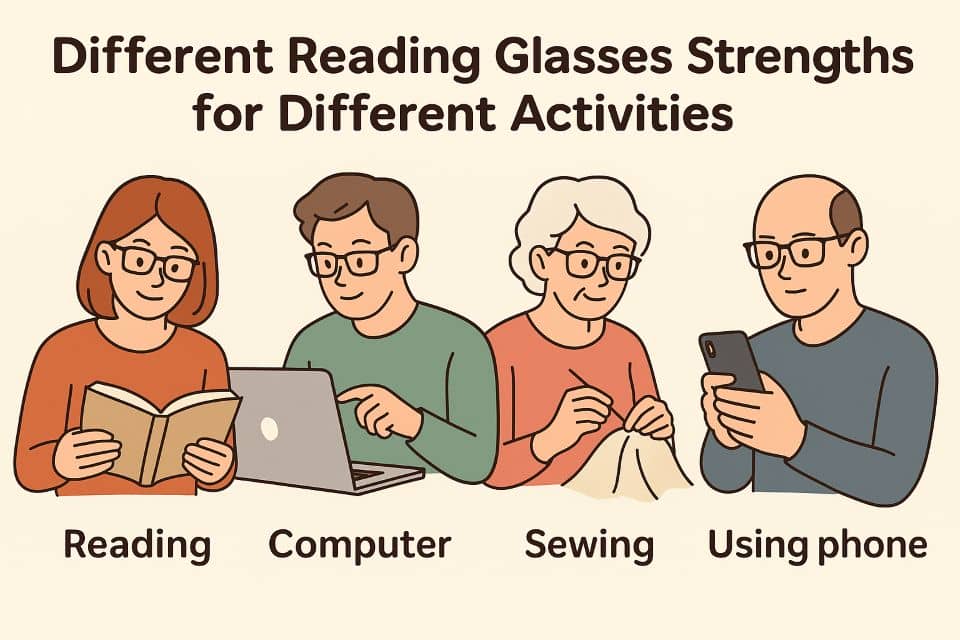
Different Reading Glasses Strengths for Different Activities
Have you ever noticed that the same pair of reading glasses doesn’t feel perfect for every situation? You might find one pair great for books but too strong for the computer — or just right for your phone but blurry when reading at a desk. That’s because different activities require different reading glasses strengths, depending on how far your eyes are from what you’re focusing on.
Just like you wouldn’t wear the same shoes for running and hiking, it makes sense to have different magnification powers for different tasks. Here’s how to match your reading glasses to your daily routine.
1. For Reading Books and Magazines
If you’re someone who loves curling up with a novel or flipping through a magazine, you’ll want slightly stronger glasses since your eyes are focused at a shorter distance.
- Ideal Strength: +1.75 to +2.50
- Why: Books are typically held around 12–14 inches away, which demands higher magnification power for crisp, effortless reading.
- Tip: If you tend to read for hours, choose lightweight frames with anti-fatigue lenses to reduce eye strain.
2. For Computer or Laptop Use
Working on a screen all day? You’ll need less strength than your book-reading pair, since monitors are generally farther away — around 18–24 inches from your eyes.
- Ideal Strength: +1.25 to +1.75
- Why: Lower power allows you to focus comfortably at a medium distance without making objects look too large or blurry.
- Bonus: Consider blue light reading glasses for added digital eye protection.
3. For Phone or Tablet Reading
Most people hold their phone closer than books or laptops, meaning you’ll need a touch more magnification for small text and backlit screens.
- Ideal Strength: +1.75 to +2.25
- Why: Smaller fonts and close range require sharper focus and slightly stronger lenses.
- Pro Tip: Keep a compact, foldable pair in your bag or pocket for quick access.
4. For Crafting, Sewing, or Detail Work
Hobbies that involve small details — like embroidery, painting miniatures, or jewelry design — require precision and close focusing distance.
- Ideal Strength: +2.25 to +3.00
- Why: These activities often involve working within 8–10 inches of your eyes, where high reading glasses power is essential.
- Bonus: Choose frames with flexible arms or magnifying clip-ons for hands-free convenience.
5. For Outdoor or Occasional Use
Maybe you just need a quick visual boost — reading a map, checking a restaurant menu, or tying a fishing knot outdoors.
- Ideal Strength: +1.00 to +1.50
- Why: Lower power keeps things natural and avoids over-magnification in bright or changing light.
- Bonus: Polarized or tinted reading sunglasses are perfect for outdoor readers.
6. Why You Might Need More Than One Pair
There’s no rule saying you must stick to a single pair of glasses. In fact, most people find it useful to keep multiple reading glasses strengths — one for work, one for reading, and maybe one just for hobbies. Many brands, including Lensalter, now offer multi-pack reading glasses in stylish designs, so you can mix practicality with personality.
Having multiple strengths also helps reduce fatigue. Instead of forcing your eyes to adapt to one “universal” pair, you give them exactly what they need for each situation — clear, effortless focus every time.
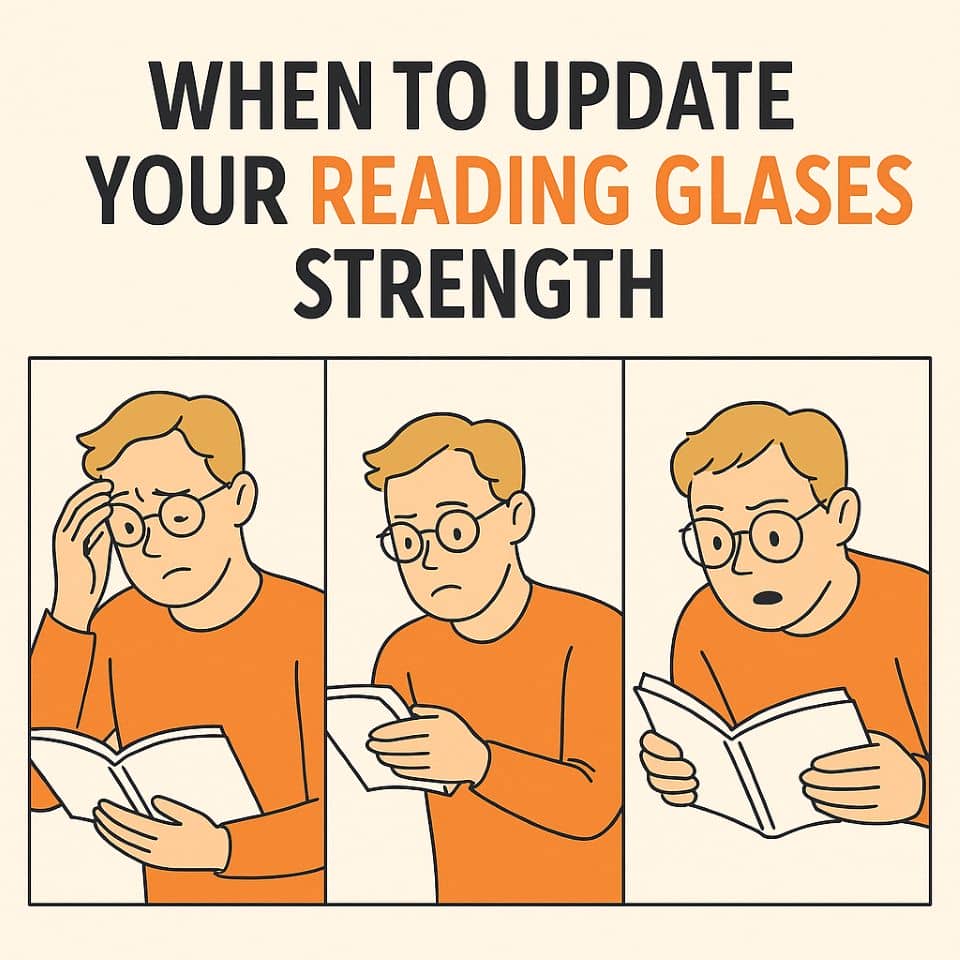
When to Update Your Reading Glasses Strength
If you’ve been wearing the same pair of reading glasses for a while and things don’t look as clear as they used to, it might be time for an upgrade. Just like your phone or laptop, your eyes change over time — and so should your reading glasses strength.
1. When You Start Noticing the Signs
Your vision won’t suddenly blur overnight, but subtle changes can sneak up on you. If you find yourself holding books or your phone farther away again, or you’re squinting under good lighting, that’s your eyes telling you it’s time to update your reading glasses strength.
Other common signs include:
- Frequent eye strain or mild headaches after reading
- Feeling like the text “moves” or shifts after long focus
- Needing to remove your glasses to see distant objects clearly
These are early hints that your current magnification may no longer match your needs. Typically, most people’s eyes change every 1–2 years, especially between ages 40 and 60, as presbyopia gradually progresses.
If you’re noticing these symptoms more often, it’s a good time to test new reading glasses power or consult an eye care professional for an updated assessment.
2. When Your Lifestyle or Habits Change
Even if your vision stays about the same, your daily habits might change — and that can affect what kind of reading glasses strength works best for you.
Let’s say you’ve started working remotely and now spend eight hours a day on your laptop. The pair that once worked perfectly for quick reading might now cause strain. You might need a slightly weaker pair (like going from +2.00 to +1.50) for mid-range tasks like screen reading, while keeping your stronger pair for books or paperwork.
The same applies if you’ve picked up new hobbies — like painting miniatures, sewing, or gardening. Each activity demands different visual distances, so adjusting your reading glasses power can make your vision feel more natural and relaxed.
Think of your eyes as adapting tools: they need fine-tuning to match how you use them. Updating your reading glasses strength isn’t just about aging — it’s about keeping up with how your lifestyle evolves.
3. When You Want Better Comfort and Clarity
Sometimes the need for an update isn’t about blurry vision — it’s about comfort. If your current glasses feel too heavy, slip down your nose, or give you headaches after long wear, it’s worth exploring newer options. Modern designs like those from Lensalter feature lightweight reading glasses for men and women with multiple strengths, anti-fatigue coatings, and blue-light protection for digital users.
Even a small change in diopter power — say from +1.75 to +2.00 — can make reading smoother and reduce fatigue. And because presbyopia correction is a gradual process, you might notice that fine-tuning your strength every year or two keeps your vision crisp and comfortable.
Updating your glasses isn’t just about necessity — it’s about quality of life. The right reading glasses strength can turn eye strain into effortless focus, helping you stay productive, comfortable, and confident no matter what you’re reading.
Stylish and Functional Reading Glasses Recommendations
Who says reading glasses have to look boring? Today’s eyewear world has completely transformed what it means to wear readers. Instead of bulky, plain designs, you can now find stylish reading glasses that double as fashion accessories — combining comfort, clarity, and confidence in one pair.
If you’ve been hesitating to wear readers because you think they’ll make you “look older,” think again. The latest collections, especially from modern brands like Lensalter, prove that reading glasses can be sleek, expressive, and perfectly in tune with your personal style.
1. Classic and Timeless Styles
If you love simplicity with a touch of sophistication, go for black rectangular reading glasses or round acetate frames. These designs are universally flattering and work well for both men and women. The Lensalter Classic Series is a perfect example — offering timeless silhouettes that pair effortlessly with business attire or casual outfits.
These frames aren’t just fashionable; they’re built for daily use. With durable hinges, lightweight materials, and smooth finishes, they make wearing glasses feel natural, not necessary.
2. Modern and Trendy Frames
Prefer something that stands out a little more? Try fashion reading glasses with bold color accents, transparent frames, or metal details. Modern readers now mirror designer trends — think geometric shapes, matte finishes, or even Y2K-inspired frames that give your look a fresh, youthful edge.
For those who spend long hours at work or scrolling on screens, blue light reading glasses from Lensalter are a smart pick. They reduce digital eye strain and glare while keeping your vision clear and comfortable — perfect for anyone balancing work and leisure online.
3. Comfort-First Functional Designs
Even the best-looking pair won’t help if it’s uncomfortable. That’s why lightweight reading glasses with flexible arms or nose pads are worth every penny. They’re designed for extended wear — whether you’re reading, crafting, or working on your laptop.
Lensalter’s ergonomic designs focus on comfort, balance, and fit, so your glasses sit perfectly all day without slipping or pinching. Some models even come with multi-pack reading glasses, letting you keep one pair at home, another at work, and one in your bag — so you’re always covered wherever you go.
Final Thoughts:
Choosing the right reading glasses strength doesn’t have to be complicated — it’s all about comfort, clarity, and confidence. Once you understand your magnification power and reading distance, you’ll quickly discover what feels best for your eyes.
Whether you’re reading a novel, working on your laptop, or scrolling through your phone, having the proper reading glasses can make every task effortless. And with today’s stylish options — like Lensalter reading glasses for men and women — you don’t have to choose between function and fashion.
Take a few minutes to test your strength, explore different styles, and find the pair that truly fits your lifestyle. Because when your vision feels right, everything else comes into focus.
Frequently Asked Questions (FAQs)
Extended Reading
